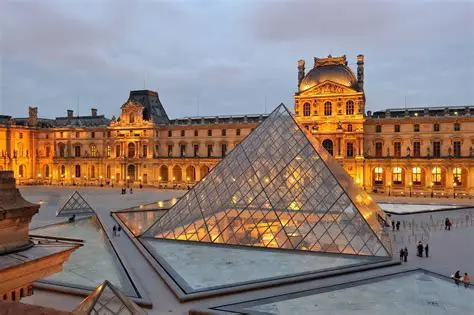
Paris, France
The world's most visited museum, housing works spanning from ancient civilizations to the 19th century — including the Mona Lisa — inside a former royal palace.
| Location | Rue de Rivoli, 75001 Paris, France |
| Access | Metro Line 1 or 7, Palais Royal–Musée du Louvre station |
| Opened | 1793, during the French Revolution |
| Collection size | 35,000–38,000 works on display, ~500,000 items total |
The Louvre was originally built as a fortress in the late 12th century, later became a royal palace, and finally opened to the public as a museum in 1793. Today it's organized into three wings — Denon, Sully, and Richelieu — wrapped around the glass Pyramid entrance in the Cour Napoléon.
The Denon Wing holds the Mona Lisa and Italian Renaissance masters, plus French Romantic paintings and the Galerie d'Apollon. The Sully Wing, the museum's oldest section, houses the Venus de Milo and Egyptian antiquities above the medieval fortress foundations. The Richelieu Wing covers Northern European painting and the Napoleon III Apartments.

Leonardo da Vinci's portrait, painted in oil on a poplar wood panel between 1503 and 1519, hangs in the Salle des États — smaller in person than most expect, at just 77 × 53 cm.
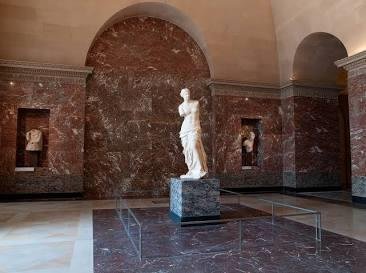
A Hellenistic marble statue of Aphrodite, carved between 150–125 BCE and unearthed on the Greek island of Milos in 1820, missing both arms to this day.
The Louvre Pyramid was designed by Chinese-American architect I.M. Pei and only opened in 1989 — much newer than the palace around it.
The Mona Lisa was stolen in 1911 by a Louvre handyman who hid it under his coat overnight — it wasn't recovered for two years.
No one knows what the Venus de Milo's missing arms were originally holding — theories range from an apple to a mirror.
The exhibition galleries cover more than 70,000 square meters — about 15 acres of floor space.